
 By admin
Each moment of network loss in a warehouse has the potential to cost time, money, and effectiveness. Barcode scanners become ineffective; security cameras hang, and automated systems become invisible, right at the time when speed and accuracy matter.
Unreliable connectivity due to harsh environments, lengthy cables, and an explosion of connected devices is a problem for many logistics facilities. These issues have the ability to slow down deliveries, decrease productivity, and escalate the operational costs, making the stability of the network a decisive concern for modern warehouses.
Fortunately, network design is not something that has to be a bottleneck. With the appropriate industrial switching solutions, warehouses gain uniform uptime, improved performance, and simplified management of the networks.
Switches can enhance the resiliency of the critical system, reduce unplanned downtime, and facilitate a smooth integration of automated equipment, IoT, and other smart technologies in the warehouse. They also offer scalability and allow networks to increase with the expansion without significant restructuring.
This article explores four industrial switch types commonly used in warehouses and logistics operations, explains where each fits best, and helps you match the right switch to real-world operational needs.
Warehouse Network Demands
Modern warehouses rely on constant connectivity for cameras, access control systems, barcode scanners, robotics, and environmental sensors. These devices operate across large floor plans and must perform reliably despite vibration, dust, and temperature fluctuations. Standard office-grade networking equipment often fails to withstand these conditions.
This is where industrial switches become essential. These switches are built with durability and reliability in use to sustain the industrial Ethernet standard, hardened enclosures, and Power over Ethernet to facilitate easy deployment.
In logistics environments, uptime is not optional. Equipment downtime in warehousing and distribution centers can negatively impact both fulfillment speed and workplace safety. These risks can be addressed with the help of industrial-grade networking infrastructure that provides the flow of data on which operations rely most.
With these operational demands in mind, selecting the right type of industrial switch becomes a strategic decision that directly impacts reliability, scalability, and day-to-day warehouse performance. Below are the four industrial switch types for warehouses and logistics.
1. 8-Port PoE Switch for Compact Zones
An 8-port PoE Industrial Switch fits well in smaller warehouse zones or edge locations. These areas typically support a limited number of devices, such as IP cameras, badge readers, or wireless access points. Compact switches allow teams to deploy networking hardware closer to equipment, which reduces cable length and minimizes signal loss.
The 8xPoE Industrial Switch (compact model) supports streamlined installations where space is limited. Power over Ethernet saves one the hassle of having separate power supplies, and it is much easier to maintain and therefore reduces installation costs.
This switch type works well for security perimeters, loading docks, or isolated storage areas. For facilities expanding in phases, compact PoE switches also offer a practical way to extend networks incrementally without overbuilding infrastructure.
2. 48-Port PoE Switch for High-Density Operations 
Large distribution centers often require high port density to support dozens of connected devices within a single zone. Camera arrays, conveyor systems, and warehouse management terminals all compete for reliable network access. A high-capacity switch simplifies network architecture by centralizing these connections.
The 48xPoE Industrial Switch meets this requirement with a high prevalence of ports and a steady supply of power. Rather than installing a number of smaller switches, operations teams can save complexity by depending on one high-density unit.
Industrial Ethernet design guidance consistently shows that reducing the number of network hops improves performance and minimizes potential failure points in industrial environments. High-port-count switches help achieve this by consolidating connections while maintaining industrial-grade resilience.
3. 8-Port PoE Switch for Flexible Layouts
Not all warehouses are in need of high-density connectivity, but they may require flexibility. Reconfigurable zones, temporary staging areas, and seasonal expansion spaces benefit from adaptable networking hardware that can move as workflows change.
The 8xPoE Industrial Switch features versatile designs with a sufficient number of ports to support an average number of devices and is simple to reposition. Its PoE capability enables quick redeployment without reworking the electrical infrastructure.
This switch type proves especially useful for facilities adopting mobile workstations or autonomous guided vehicles. As logistics workflows evolve, flexible networking ensures infrastructure keeps pace with operational changes rather than limiting them.
4. 16-Port PoE Switch For Balanced Scalability
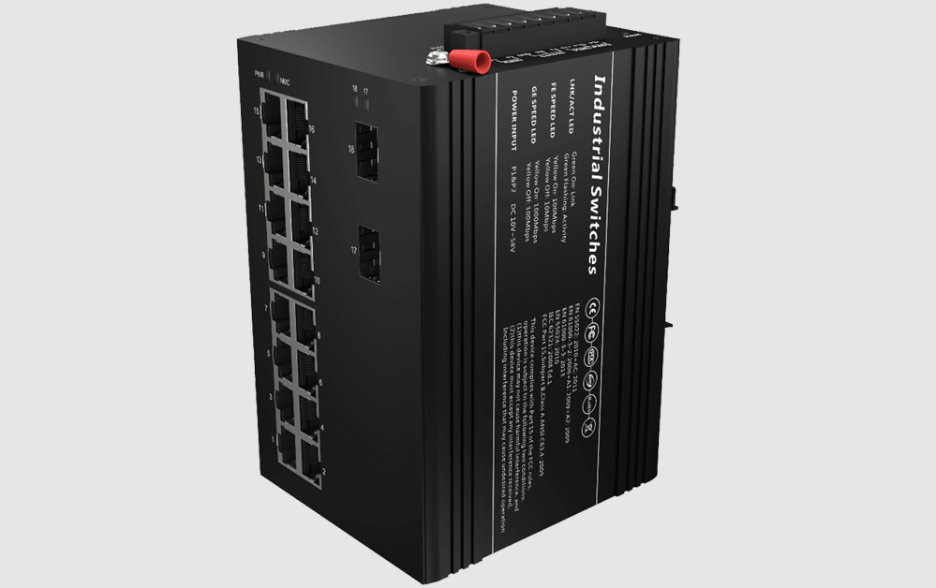
A 16-port PoE Industrial Switch strikes a balance between compact and high-density options. Many mid-sized warehouse zones require more connectivity than an 8-port model provides, yet do not justify a full 48-port deployment.
The 16xPoE Industrial Switch supports scalable growth without unnecessary overhead. This configuration suits sorting lines, quality control stations, and integrated automation cells where device counts gradually increase.
The IEEE overview of PoE demonstrates how modern Power over Ethernet standards deliver efficient power to industrial equipment while maintaining reliable data transmission. A 16-port switch utilizes these standards without sophisticated complexity in the network.
Conclusion
Warehouse and logistics networks require much more than simple connectivity. Industrial switches come in different types, with smaller edge switch designs supporting devices on a specified edge, and larger switch designs supporting the larger, centralized systems. Understanding these functions enables the network infrastructure to be near the actual workflow in the warehouse.
The choice of the type of switch has a direct impact on performance, reliability, and scalability in the long run, with aligned switch capacity, durability, and power dispersion. Network interruptions decline, and the efficiency of the systems increases throughout the facility when the demands in the environment and operations are aligned.
The key takeaway is simple: design the network with intention. Selecting the right industrial switch in each zone will empower uptime, ease future expansions, and provide a solid base of automation and intelligent warehouse systems.